Buying your first metal guitar should be exciting. For a lot of people it turns…
6-String vs 7-String: Do You Actually Need the Extra String?
At some point most metal players look at a 7-string and wonder whether they’re missing out. The bands you love are using them. The riffs sound lower and heavier than anything you can get out of six strings. Surely one more string is the answer?
Sometimes it is. Sometimes a different tuning or a baritone would serve you better. And sometimes the 6-string you already own is doing the job just fine. Here’s an honest look at what a seventh string gives you, what it costs you, and how to work out which camp you’re in.
What the seventh string actually gives you
A standard 7-string is tuned B E A D G B E. It’s a normal 6-string in standard tuning with a low B added underneath.
That’s the key point. You’re not swapping your existing range for a lower one. You’re adding to it. You keep everything you already know on the top six strings: the chord shapes, the scale patterns, the solos. Then you get five extra notes below the low E.
Compare that to tuning a 6-string down to B standard. You get the same low note, but the whole guitar moves with it. Your top string is now a B instead of an E, so you lose range at the top. Every familiar shape now sounds a fourth lower.
So the real question isn’t how low you want to go. It’s whether you want to go low and keep your top end, or whether you’re happy to shift the whole guitar down.
The three ways to get heavy
If you’re after that deeper register, you’ve got three realistic options.
1. Drop or down-tune a 6-string. This is the cheapest option, because you probably already own the guitar. Drop D, drop C and even B standard work well on a 25.5″ scale with the right gauge and a proper setup. We covered the details in Setting Up a Guitar for Drop Tuning. The downside is that each step lower puts more strain on string tension, and you give up your top end.
2. Go baritone. A baritone is a 6-string with a longer scale, built to live in low tunings. The Spira T-400 Baritone runs a 27″ scale and ships strung 12–59. That holds proper tension in B and below, where a standard scale starts to go slack. It’s still six strings, so everything feels familiar, but the whole range sits lower. It’s ideal if you mostly play riffs and rarely go above the 12th fret on the high E.
3. Go 7-string. Low B plus your full standard range, on one neck. It’s the most versatile option if your music moves between crushing low riffs and leads high on the neck, often in the same song.
There’s no single correct answer. It mostly depends on where your playing sits on the neck.
What changes when you pick one up
A 7-string isn’t hard to play, but it does feel different for the first few weeks. Here’s what to expect.
The neck is wider. Spira 7-strings have a 48mm nut, compared with 43mm on our 6-strings. That’s not dramatic, but your thumb will notice it at first, especially if you play with it over the top of the neck. Our 7-strings use the same Modern D profile and 14″ radius as the 6-strings, so once your hand adjusts to the width, the neck itself feels familiar.
Muting becomes a skill. One more string means one more string ringing when you don’t want it to. Your picking hand palm and spare fretting-hand fingers need to work harder to keep the low B quiet during leads. Most players get there within a week or two, and a noise gate helps on stage.
Your reference point moves. You’ve spent years thinking of the thickest string as E. Now it’s B. Your eyes and hands will reach for the wrong string a few times. This is the biggest adjustment, and also the quickest to fade.
Scale length matters more. A low B needs tension to stay tight, which is why longer scales suit 7-strings so well. Spira 7-strings run a 26.5″ scale across the range. The S-457 goes further with a multiscale 25.5″–27″ fretboard. That puts the long scale where the low strings need it and keeps the treble side at a comfortable 25.5″.
Who should go 7-string
It makes sense if you:
- Play modern metal, djent, prog or metalcore, where so much of the material is written for low B or lower.
- Want low riffs and high leads in the same song without changing guitars.
- Keep down-tuning your 6-string and missing the top end you used to have.
- Write music and want more range to work with: extended chord voicings, wider intervals, bass-register lines under your melodies.
- Play in a band that’s already moved down, and you’re tired of retuning between songs.
You might be better off with a 6-string or a baritone if:
- You play mostly classic metal, hard rock or punk, which is largely written for E standard, drop D or Eb.
- Your low end is all riffs and you rarely solo high up. A baritone gives you the weight with a familiar feel.
- You love big bends, wide vibrato and playing over the top of the neck with your thumb. A narrower neck is just more comfortable for that.
- You’re still building your fundamentals. Everything you learn on a 6-string carries straight over, so there’s no rush.
Where to start with a Spira 7-string
If you’ve decided the seventh string is for you, the range covers a lot of ground.
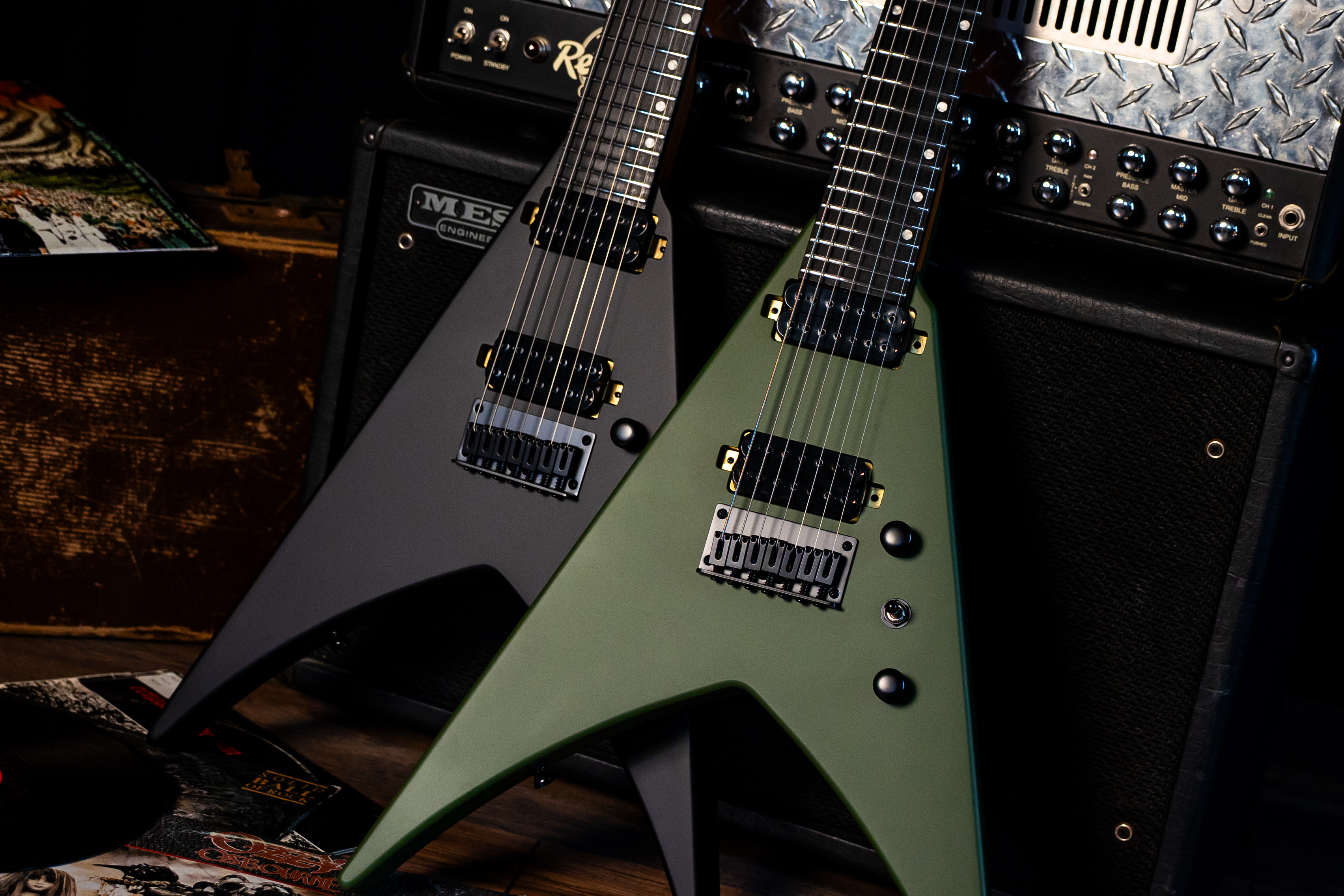
The 400 Series is the natural starting point. The S-407, T-407, V-407 and X-407 all use the same setup: a roasted poplar body, Canadian roasted maple neck, Ebony Tech fretboard, 24 jumbo frets, fixed bridge, locking tuners and Villain 7-string humbuckers. So pick the shape that suits you. If you’re not sure, our guide to Spira body shapes breaks down how each one sits and plays.
The S-457 adds the multiscale fretboard, a roasted maple fretboard and a quilted maple top. It’s a good choice if you want a tighter low end and the most natural feel across all seven strings.
The S-607 steps up to a lightweight swamp ash body, stainless steel frets and Spira’s new high-mass hardtail bridge. It’s built for players who’ll be living on the low B for long gigs.
The S-1007 PRO is the top of the range. It has a set neck, a Black Limba body with a Wenge top, an ebony fretboard and the new hand-wound Villain PRO Alnico V pickups. It’s made for players who want a professional instrument with extended range.
Every Spira 7-string ships strung 10–59, ready for B standard straight out of the box.
The takeaway
A 7-string isn’t a must-have, and it isn’t just a gimmick. It’s a tool for a specific job: getting heavy low end without giving up your top range. If your music lives in that space, the seventh string will feel like the guitar you should have had all along. If it doesn’t, a well set-up 6-string or a baritone will get you the weight with less to relearn.
The best test is your hands. Find your nearest Spira dealer, pick up a 7-string next to a 6-string, and play your heaviest riff on both.

Related Posts